
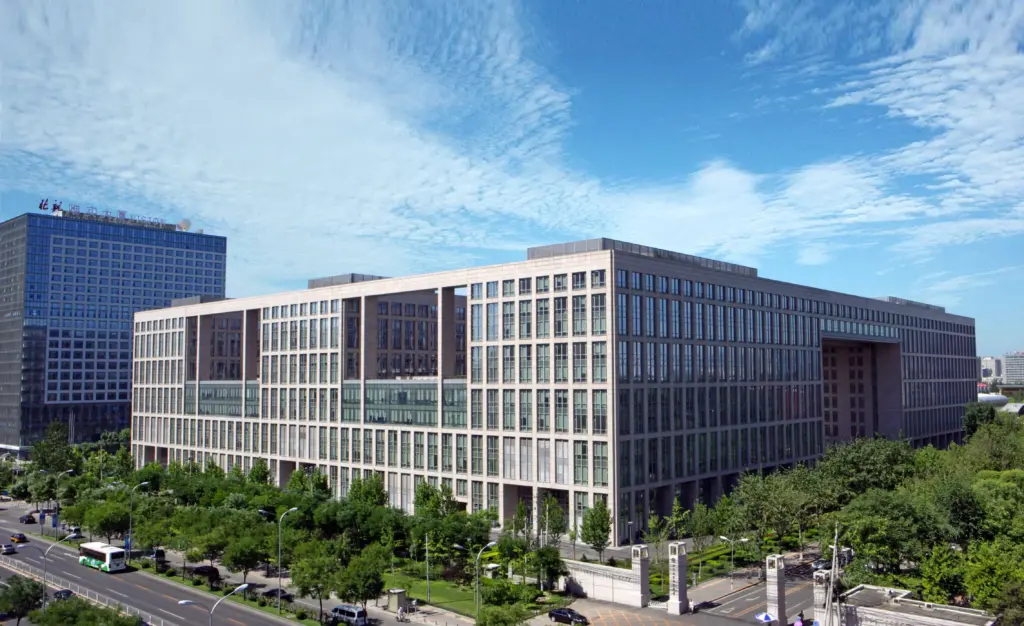
Beihang University
Beihang University
Tell us about your profile and we will answer for this university: your chances, the deadlines and what to prepare.
Photo: HoweyYuan · CC BY-SA 4.0 · Wikimedia Commons
Shortlist a few and we'll compare them side by side and assess each one.
History and Reputation
Beihang University (北京航空航天大学, abbreviated BUAA) was established in October 1952 as the first aerospace-focused higher education institution in the People's Republic of China. Born from the merger of aeronautical departments from eight leading Chinese universities—including Tsinghua University, Tianjin University (formerly Beiyang University), and Xiamen University (formerly Amoy University)—it was originally named the Beijing Institute of Aeronautics, renamed Beijing University of Aeronautics and Astronautics in 1988, and adopted the shortened name "Beihang" in 2002 while retaining the English acronym BUAA. From its inception, Beihang has held national key university status: recognised as a national key institution in 1959, it joined Project 211 in 1997, Project 985 in 2001, and was selected for the first tier (Class A) of China's Double First-Class University initiative in 2017.
In the 2026 international rankings, Beihang consistently ranks among the world's elite: 251–300 in the Times Higher Education World University Rankings, 101–150 in the Shanghai Ranking (ARWU), 198th globally in the CWUR (top 1% worldwide), and 11th among all Chinese universities. The subject rankings are even more striking: Aerospace Engineering ranks #1 globally, Instruments Science & Technology #2, Mechanical Engineering #7, Computer Science in the top 100, and Engineering overall at 88th (THE 2026). These accolades reflect seven decades of dedicated research and teaching excellence, rooted in the university's original mission to advance China's aerospace capabilities and now extended across engineering, natural sciences, humanities, social sciences, management, law, philosophy, education, medicine, and art.
Chinese universities tighten portfolio and motivation-letter requirements every year — we track this university by university, so every application matches what the admissions committee actually expects right now.
Academic Strengths and Research Excellence
Beihang's core disciplines—Aeronautical and Astronautical Science and Technology, Instruments Science and Technology, Computer Science and Technology, and Management Science and Engineering—hold national key discipline status. Two first-level disciplines, Aeronautical and Astronautical Science and Technology (航空宇航科学与技术) and Mechanics (力学), are designated as national world-class disciplines. Notably, Beihang's Aerospace Engineering has ranked #1 in the world in the Shanghai Ranking's Global Ranking of Academic Subjects for seven consecutive years. The School of Aeronautic Science and Engineering, founded in 1952 as the Department of Aircraft under the legendary scientist and academician Tu Shou'e (winner of the "Two Bombs, One Satellite" Merit Medal), serves as the university's flagship school, leading research in aircraft design, aerodynamics, structures and strength, flight mechanics, and human-machine environmental control.
Beihang operates a formidable portfolio of research platforms: the National Laboratory of Computational Fluid Dynamics, the National Key Laboratory of Aircraft Strength and Structural Integrity (deputy director unit), Ministry of Education (MOE) Key Laboratory for Fluid Mechanics, Ministry of Industry and Information Technology (MIIT) key laboratories in advanced aircraft design technology, aero-acoustics, and high-speed vehicle thermal strength, and Beijing-level key laboratories in advanced VTOL (vertical take-off and landing) aircraft technology and powder technology. Recent infrastructure includes a state-of-the-art 4×3-metre aero-acoustic wind tunnel and a next-generation fully digital aircraft research and teaching platform that integrates virtual simulation with physical validation. Beyond aerospace, Beihang has expanded strategically by establishing the Research Institute of Aero-Engine (jointly with Aero Engine Corporation of China, AECC), the Institute of Unmanned Systems, the Institute of Artificial Intelligence, and the International Institute for Interdisciplinary and Frontiers research.
Beihang's legacy of innovation includes landmark achievements: the Beijing-1 light passenger aircraft (1958), China's first sounding rocket Beijing-2 (1958), the first Chinese UAV Beijing-5 (1958), the Wuzhen-5 combat reconnaissance drone (1969), and the Seagull coaxial dual-rotor helicopter (1995). Today, Beihang researchers and alumni participate in virtually every major Chinese aerospace and defence programme, from large commercial aircraft to carrier-based fighters and deep-space exploration missions. The university is home to the Sino-French École Centrale de Pékin (established in 2005 with France's Groupe des Écoles Centrales, recognised internationally for engineering education excellence) and the UN Regional Center for Space Science and Technology Education in Asia and the Pacific (China), established in November 2014.
Show the full profile
Campus and Life in Beijing's Innovation Hub
Beihang operates two campuses in Beijing covering over 200 hectares. The main Xueyuan Road Campus (学院路校区), occupying roughly 1 km², sits at the heart of Zhongguancun Science Park—often called "China's Silicon Valley"—in the Haidian District, adjacent to the Olympic Centre and well-served by metro. This location places students in an unrivalled ecosystem of high-tech startups, research institutes, and peer universities (Tsinghua, Peking University, and others), offering abundant opportunities for internships, collaboration, and professional networking. The second campus, Shahe (沙河校区), is similarly sized and located 20 kilometres northwest in Changping District; it houses the National Laboratory on Aerospace and hosts many undergraduates in their early years.
International students reside in Building 10 of Dayuncun on the Xueyuan Road Campus (southwest corner, near the subway station) or Apartment 11 on Shahe Campus, depending on their school affiliation. Rooms are equipped with beds, desks, chairs, wardrobes, air conditioning, wireless internet, and private bathrooms. The Dayuncun area features a sunken plaza with shops, laundry services, parcel lockers, and other amenities, forming a relatively self-contained community. Beihang enrolls over 29,000 students, including more than 1,700 international students from nearly 90 countries. The faculty numbers over 2,000, among them 20 members of the Chinese Academy of Sciences and Chinese Academy of Engineering. Beihang maintains partnerships with 185 universities, research institutions, and corporations across more than 30 countries, participates in the T.I.M.E. (Top Industrial Managers for Europe) consortium, and operates a representative office in Brussels.
Competition and entry requirements
As a top-10 national university and a Class A Double First-Class institution, Beihang is highly selective. For undergraduate admission in the 2026–2027 academic year, applicants must be non-Chinese citizens aged 18–22, hold a senior high school diploma (or expected graduation certificate, verified at registration), meet the requirements of the PRC Nationality Law and MOE Document No. 12 (2020), and be in good health.
A critical recent development is the mandatory China Scholastic Competency Assessment (CSCA, 来华留学本科入学学业水平测试), organised by the China Scholarship Council (CSC). The requirement for CSCA, the specific subjects tested, and the test language depend on the target university, programme, and admission year; applicants must verify the exact requirements officially with the university and CSCA before registering. For 2026 Beihang applicants, the exam typically required Mathematics (mandatory for all) and optional subjects—Physics and/or Chemistry (for science, engineering, agriculture, or medicine programmes)—plus Professional Chinese (for Chinese-taught programmes; applicants to fully English-taught programmes are exempt). CSCA is offered multiple times per year (in 2026: January, March, April, June, and December) and available in three formats: home-based online proctored, computer-based at test centres, or paper-based. Applicants must upload their CSCA transcript to Beihang's application system by May 30, 2026, at the latest.
Language requirements: for Chinese-taught programmes, HSK Level 5 or above with a score of no less than 180 (valid within two years); for English-taught programmes, TOEFL 90+, IELTS 6.0+, or proof that all high school coursework was conducted in English (also valid within two years). The application window for undergraduate admission 2026–2027 runs from November 1, 2025, to June 30, 2026. Pre-admission decisions are released in batches (March, April, and June 2026), official admission letters in July, and registration in August or September 2026. Applications are submitted online via admission.buaa.edu.cn; the application fee is RMB 400 (approx. USD $70).
For master's programmes, applicants must hold a bachelor's degree, be under 35 years of age, and meet language requirements (HSK 5+ with 180+ for Chinese-taught; IELTS 6.0, TOEFL 90, or Duolingo 105 for English-taught). Additional documents include an acceptance letter from a Beihang supervisor, a study plan of at least 1,000 words, two letters of recommendation from professors, a Foreigner Physical Examination Form, a certificate of non-criminal record, and proof of financial support. For doctoral programmes, applicants must hold a master's degree and be under 40. The application deadlines for 2026–2027 master's and doctoral programmes are the same: November 1, 2025, to June 30, 2026.
Scholarships and Financial Support
Beihang is an authorised host institution for several Chinese Government Scholarship (CGS) programmes. Full scholarships typically cover tuition, accommodation in university dormitories (or housing subsidy: RMB 700/month for master's, RMB 1,000/month for doctoral students), monthly stipend (RMB 3,000 for master's, RMB 3,500 for doctoral students), and comprehensive medical and accident insurance; international airfare is generally not covered.
For 2026–2027 postgraduate admission, the CGS High-level Postgraduate Program (Type B; Beihang's agency number is 10006) and the Belt & Road Program are available. Applications are accepted in three batches: the first by December 10, 2025; the second by January 10, 2026; the third by February 28, 2026 (Belt & Road deadline: May 25, 2026). Candidates must apply simultaneously through the CSC system (studyinchina.csc.edu.cn) and Beihang's application system (admission.buaa.edu.cn); inconsistencies between the two will result in rejection. Pre-admission notices are issued in rolling batches; final admission is confirmed in summer, with registration in September 2026.
Beihang also participates in the Youth of Excellence Scheme of China (Type A, agency number 1563) for three master's programmes in global management talent development. This scholarship is for applicants under 45 years of age, holding a bachelor's degree or higher, with at least three years of professional experience in government (division level or above), senior management in institutions or enterprises, university or research administration, or international organisations. The "1+1" mode involves one year of full-time study and research preparation at Beihang, followed by one year of dissertation work in the home country and defence in China; the scholarship covers one year of living expenses. Pre-admission applications are due by March 15, 2026; CSC applications by March 31, 2026. All dates, amounts, and scholarship terms depend on the specific programme and admission year; applicants must verify current conditions on Beihang's and CSC's official websites before applying.
How we help you apply
Beihang University is one of China's most competitive institutions, and a successful application demands meticulous preparation: timely CSCA registration, selecting the correct subjects and test language, meeting language proficiency requirements (HSK or IELTS/TOEFL), securing an acceptance letter from a Beihang supervisor (for postgraduates), dual submission to both Beihang and CSC systems (for scholarship applicants), and crafting a compelling motivation letter, research plan, and CV. The UNIPROFI team guides applicants through every stage—from programme selection and CSCA preparation to document submission and final admission.
For those targeting Beihang's elite engineering and aerospace programmes, UNIPROFI offers the Admission to China's Top-10 Universities service. This comprehensive package includes a personalised admission strategy, development of a strong CV and motivation letter, assistance in identifying and contacting potential supervisors, consultations with experts from leading universities (including Tsinghua University), preparation of a full application dossier for both university and scholarship applications, and continuous support until enrolment. For applicants who need targeted assistance with CSCA, UNIPROFI provides CSCA prep: foundation course and CSCA prep: intensive course. If your profile is already in good shape and you need advice on choosing the right programme at Beihang or other Chinese universities, you can opt for Matching up to 5 universities to your profile or Consultation with a Tsinghua University expert. UNIPROFI works with hundreds of applicants annually, stays current with evolving requirements at Chinese universities, and helps turn the ambitious goal of studying at one of the world's top engineering universities into a tangible reality.
Tell us about yourself — we'll build an admissions strategy for this exact university.
Many students get in through our preparatory Language Year — an intensive year of Chinese at a partner university, followed by a move onto the main program.
What the Language Year isFrom application to admission
Profile review and strategy
We study your academic profile, goals and budget, assess your real chances, and shortlist universities and grants for your specific situation.
Document preparation
We help with translation, notarization, your motivation letter, CV and recommendations — tailored to each university's requirements.
Filing applications and university correspondence
We file your documents, track status, respond promptly to admissions offices, and keep every deadline under control.
Visa, move and your first weeks
We arrange your visa, insurance and medical exam, help with housing and transfer, and stay in touch after you arrive.
How we support admission here
From filing documents on your own to admission at one of China's top-10 universities — pick the level of involvement that fits you, and see exactly what's included in each tier.
If you're not admitted to any of your chosen universities, then under the terms of the agreement we'll refund your payment minus documented expenses, or support a free re-application the following year.

Common questions about admission
Why apply through UNIPROFI specifically?
UNIPROFI is about a well-thought-out application and a strong outcome: we build an application path around your profile, goals and the requirements of your selected universities. You work with mentors who are current students or graduates of these schools, so you get real understanding of the system, campuses and opportunities — not theory. We take on complex cases (including minors and admission without an 11th-grade diploma), build an individual strategy for your profile and goals, and support you through every stage, from documents to your visa.
Do you guarantee admission?
We don't offer "guarantees for the sake of a sale," because no one can directly influence a university's decision. What we do is structure everything to minimize the risk of rejection — matching you to the right universities, building a strong application strategy, and preparing documents carefully. Any refund or re-application arrangement is governed only by the current service agreement and the circumstances of the case.
What are my actual chances of getting in?
We do not state a universal admission probability because the decision belongs to the university. We instead assess your profile, programme requirements and application strategy.
Can I apply on my own — why do I need you?
You can, but most students end up losing time, making mistakes, or settling for weaker universities. We save you months, help you start at a stronger level, and prevent the mistakes that can cost you admission.
Get in touch to get started
Tell us about yourself and what you're specifically interested in — our specialists will help you find the right format.