
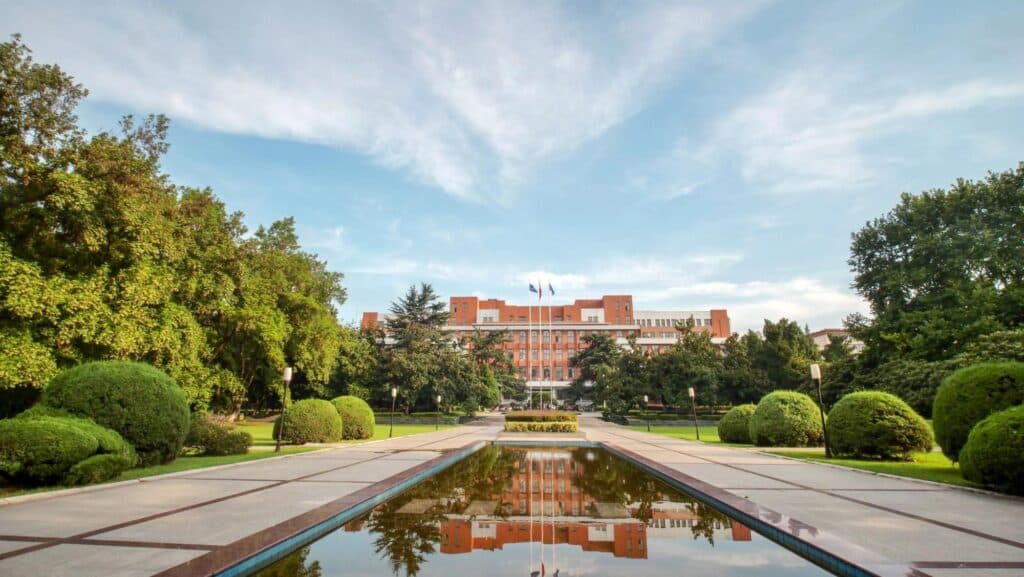
University of Science and Technology of China
University of Science and Technology of China
Tell us about your profile and we will answer for this university: your chances, the deadlines and what to prepare.
Shortlist a few and we'll compare them side by side and assess each one.
History and Reputation
Founded in 1958 by the Chinese Academy of Sciences (CAS) in Beijing at the height of the Space Age, the University of Science and Technology of China (USTC, 中国科学技术大学) was designed from the outset to train the nation's top scientific talent. In 1970, the university relocated to Hefei, the capital of Anhui Province—a move that profoundly shaped its identity. Far from the political and commercial bustle of Beijing or Shanghai, USTC developed a famously austere, research-first culture, often described as "science-monastic," where faculty and students focus intensely on lab work and fundamental discovery rather than networking or corporate ties.
Today USTC ranks among the world's top 50 universities: 40th globally in the 2025 Shanghai Ranking, 51st in the THE World University Rankings 2026, and an exceptional 2nd worldwide among academic institutions in the Nature Index for research output in natural sciences, chemistry, and physical sciences. The university is best known for quantum information science (home to the CAS Key Laboratory of Quantum Information and the team behind the Micius quantum satellite), condensed matter physics, nanoscience (ranked 4th globally), chemistry (5th), and physics (17th). Historically, USTC established China's first graduate school in 1978 and pioneered the legendary Special Class for the Gifted Young (少年班), which annually admits a cohort of 14- to 15-year-old prodigies with exceptional mathematical abilities—a program that has produced a disproportionate share of CAS academicians and leading tech entrepreneurs.
Chinese universities tighten portfolio and motivation-letter requirements every year — we track this university by university, so every application matches what the admissions committee actually expects right now.
Academic Strengths
USTC is first and foremost a research university with a deliberately small undergraduate intake (fewer than 1,900 freshmen per year) and an intense concentration of resources on fundamental science. It comprises 23 schools (faculties) and 6 research institutes, overwhelmingly in natural science and engineering; humanities and social sciences are present but marginal. Core strengths include the School of Physical Sciences, School of Chemistry and Materials Science, School of Computer Science and Technology, and School of Engineering Science.
The university operates 12 national research centers and four major national scientific infrastructures, including the National Synchrotron Radiation Laboratory (Hefei Light Source, China's first), the State Key Laboratory of Fire Science, the CAS Key Laboratory of Quantum Information, and the Brain-Inspired Intelligence Laboratory. Shanghai Ranking places USTC in the global top 20 for physics, chemical engineering, materials science, computer science, optics, and metallurgical engineering. Its research portfolio includes megascience projects in quantum communication, dark matter detection, and neuromorphic AI—the kind of work that defines cutting-edge research worldwide.
Prospective international students should understand that the vast majority of undergraduate and many graduate programs are taught in Chinese; English-medium programs are limited, mostly at the master's and doctoral levels (e.g., Software Engineering, select physics and chemistry tracks). The academic intensity is extremely high—USTC does not tailor its pace to accommodate international learners; the expectation is that you will match the rigor of domestic peers, many of whom arrived as national olympiad medalists. This is not a gentle on-ramp; it is a sprint alongside China's best.
Show the full profile
Campus and Life in Hefei
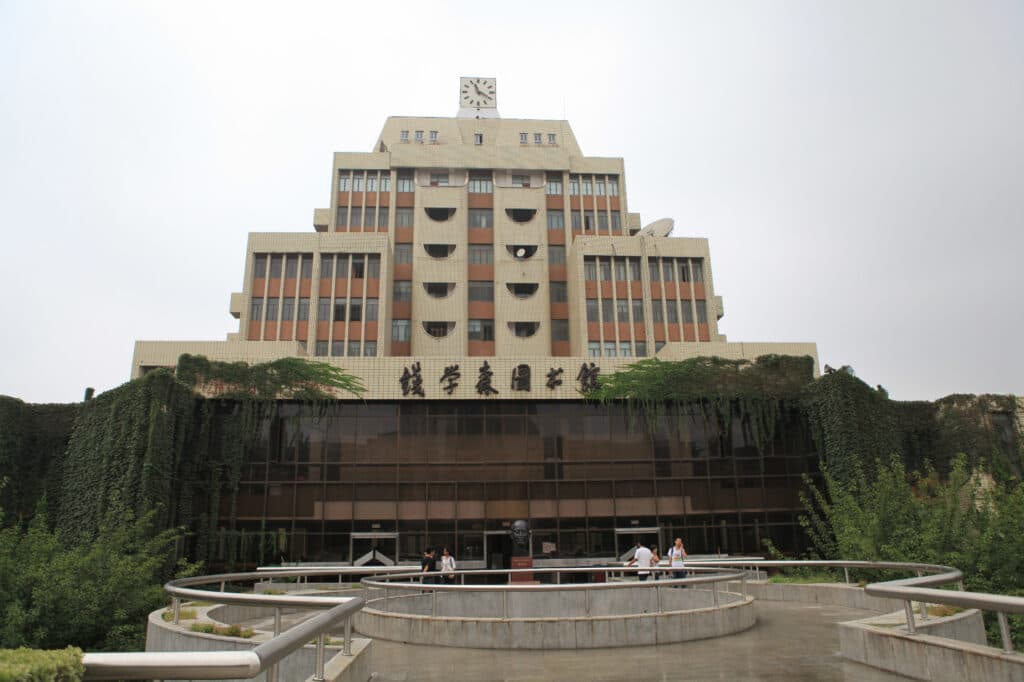
USTC operates three campuses in Hefei—East (the main hub, home to most undergraduates and international students), West, and South—connected by a campus shuttle bus system. Facilities include a six-floor main library on East Campus (open from early morning to late evening), extensive sports infrastructure (two stadiums, 20 basketball courts, badminton and table tennis halls, a gym), a variety of dining halls offering meals for around 10 yuan and including halal options, and modern dormitories. International student accommodation is equipped with air conditioning, furniture, fridges, washing machines; fees range from 500 to 1,000 yuan per month depending on room type (two- or three-bedroom shared apartments). Off-campus housing is permitted, but you must register with the local police station and obtain an accommodation certificate.
Hefei is a city of about nine million, a rapidly growing science and technology hub (it hosts CAS megaprojects like the Steady High Magnetic Field Facility), but culturally it remains a distinctly second-tier city: quieter, cheaper, and far less cosmopolitan than Beijing or Shanghai. If you're looking for the buzz of a global metropolis, ready access to multinational corporate internships, or a large international expat community, Hefei will feel limited. But if your priority is focused academic work and deep immersion in research, the environment is near-ideal: minimal distractions, low living costs, and proximity to world-class labs. High-speed rail connects Hefei to Shanghai (2.5 hours), Nanjing (1 hour), and Beijing (around 4 hours).
Campus culture is intense and competitive—"involution" (内卷) is a real phenomenon, with students routinely studying in the library late into the night. International students have access to clubs (academic societies, sports, cultural events) and the university organizes orientation programs including campus tours, visits to the Anhui Provincial Museum, and trips to Mount Dashu. However, expect that English proficiency among domestic students and administrative staff is lower than at top Beijing or Shanghai universities—basic Chinese will be essential for smooth integration.
Competition and entry requirements
USTC is a top-10 Chinese university, and competition for places is fierce. For undergraduate admission in the 2026 cycle (classes begin September 2026), the baseline requirements include a high school diploma (or certificate confirming graduation by July 2026), no upper age limit (but applicants under 18 as of September 1, 2026 must provide proof of guardianship in Hefei), Chinese language proficiency at HSK 5 or above with each section scored over 60 (exemptions available if the applicant's high school instruction was in Chinese), and crucially, results from the China Scholastic Competency Assessment (CSCA, www.csca.cn). The CSCA tests three subjects: Professional Chinese (STEM), Mathematics (compulsory), and either Physics or Chemistry (elective). The necessity of CSCA, the specific subjects required, and the testing language depend on the target university, program, and admission year; applicants should verify official requirements with the university and CSCA before registering. CSCA results must be submitted with the online application. The application window for 2026 undergraduate admission runs from November 14, 2025, to March 31, 2026. University assessment (interviews or further tests) occurs in April–May, and admission results are announced in June–July.
For graduate programs, eligibility includes holding a bachelor's degree (for master's applicants) or master's degree (for PhD applicants), being under 40 years old for master's and under 45 for doctoral candidates as of September 1, 2026 (some scholarships impose stricter age limits), and demonstrating language proficiency: HSK 4 or higher for Chinese-taught programs, or proof of English proficiency (IELTS/TOEFL or equivalent) for English-taught programs. The online application period for master's and doctoral programs runs from October 16, 2025, to January 31, 2026. Departments organize online interviews and, in some cases, written exams in February–March; admission decisions are released in June–July. There is no need to contact a potential supervisor before applying—the university distributes materials to departments, which conduct interviews and select candidates.
Required documents include a passport copy, notarized diplomas and transcripts (translated into Chinese or English), the Foreigner Physical Examination Form, a research or study proposal (for graduate applicants, minimum 1,000 words), CV, two recommendation letters from full or associate professors, and language certificates. Full details and document templates are available on the USTC International College website (ic.ustc.edu.cn/en).
Tuition and Scholarships
Tuition at USTC is relatively moderate: undergraduate programs cost 26,000 yuan per year, master's programs 30,000 yuan per year (except MBA at 150,000 yuan), and doctoral programs 35,000 yuan per year. Add to this mandatory health insurance (800 yuan per year) and on-campus accommodation (500–1,000 yuan per month), and the total annual cost of study and living comes to roughly 40,000–50,000 yuan (approximately 5,500–7,000 USD)—substantially less than tuition at most Western universities of comparable rank.
International students have access to two main scholarship channels. The first is the Chinese Government Scholarship (CSC), which covers tuition, accommodation, health insurance, and a monthly stipend (amounts set annually by CSC and vary by degree level). Applications are typically submitted through the Chinese embassy or consulate in your home country, or directly via the CSC system (campuschina.org); after receiving the award letter, you must forward it to USTC for pre-acceptance. The second channel is the USTC Fellowship, an internal university scholarship. For undergraduates, there are two levels: Level A (covers tuition, insurance, monthly stipend of 2,500 yuan, and accommodation subsidy) and Level B (tuition only). For master's students, the fellowship covers tuition, insurance, monthly stipend up to 3,000 yuan, and accommodation subsidy; for doctoral students, up to 7,000 yuan per month plus tuition, insurance, and accommodation. Applications for USTC Fellowship are submitted through the online system at the same time as the main application, and competition is keen—awards go to the strongest candidates.
Important: the university does not guarantee scholarships to all admitted students; when planning your budget, be prepared for the possibility of self-funding and consider applying to both scholarship channels simultaneously.
How we help you apply
Gaining admission to USTC is a marathon with many moving parts: registering for and preparing for the CSCA (an exam with limited study materials available in English or Russian), crafting a compelling research proposal and motivation letter that can persuade a top-10 admissions committee, navigating document notarization and translation requirements, and mastering interview formats. UNIPROFI has worked with Chinese universities for years and knows the real selection criteria, the actual deadlines, and the pitfalls that aren't obvious from official websites.
If you prefer to handle the process yourself but want access to vetted checklists and guidance, the Self-Guided Admission to China plan provides step-by-step roadmaps, up-to-date requirements, and document templates. If you need regular feedback and help at key stages (document review, application strategy, interview coaching), the Guided Admission to China plan includes a dedicated manager who will walk you through from start to finish. For those who prefer to delegate the entire process—from program selection to document translation and notarization, CSCA prep, and full application support—the Turnkey Admission to China plan is designed for that. And because USTC is in China's elite top ten, where competition is especially intense, the Admission to China's Top-10 Universities plan is tailored specifically for applicants targeting C9 League and equivalent universities: it includes strategic consultation with a Tsinghua University expert who understands the selection logic of China's top tier, professional help building a competitive profile and writing your motivation letter and research proposal, mock interviews with detailed feedback, intensive CSCA preparation, and full support until enrollment.
If you need targeted help—such as an admission strategy session for top universities, CV coaching, mock interviews, or scholarship application assistance—UNIPROFI also offers these as standalone services. USTC is a rare opportunity to study at one of Asia's premier scientific institutions, work alongside award-winning faculty, and access research infrastructure few universities in the world can match. But the path there demands not only strong academics but also precise execution of complex procedures and a deep understanding of the system. UNIPROFI knows how to guide you from initial interest to an X1 student visa and your first day in Hefei.
Tell us about yourself — we'll build an admissions strategy for this exact university.
Many students get in through our preparatory Language Year — an intensive year of Chinese at a partner university, followed by a move onto the main program.
What the Language Year isFrom application to admission
Profile review and strategy
We study your academic profile, goals and budget, assess your real chances, and shortlist universities and grants for your specific situation.
Document preparation
We help with translation, notarization, your motivation letter, CV and recommendations — tailored to each university's requirements.
Filing applications and university correspondence
We file your documents, track status, respond promptly to admissions offices, and keep every deadline under control.
Visa, move and your first weeks
We arrange your visa, insurance and medical exam, help with housing and transfer, and stay in touch after you arrive.
How we support admission here
From filing documents on your own to admission at one of China's top-10 universities — pick the level of involvement that fits you, and see exactly what's included in each tier.
If you're not admitted to any of your chosen universities, then under the terms of the agreement we'll refund your payment minus documented expenses, or support a free re-application the following year.
Common questions about admission
Why apply through UNIPROFI specifically?
UNIPROFI is about a well-thought-out application and a strong outcome: we build an application path around your profile, goals and the requirements of your selected universities. You work with mentors who are current students or graduates of these schools, so you get real understanding of the system, campuses and opportunities — not theory. We take on complex cases (including minors and admission without an 11th-grade diploma), build an individual strategy for your profile and goals, and support you through every stage, from documents to your visa.
Do you guarantee admission?
We don't offer "guarantees for the sake of a sale," because no one can directly influence a university's decision. What we do is structure everything to minimize the risk of rejection — matching you to the right universities, building a strong application strategy, and preparing documents carefully. Any refund or re-application arrangement is governed only by the current service agreement and the circumstances of the case.
What are my actual chances of getting in?
We do not state a universal admission probability because the decision belongs to the university. We instead assess your profile, programme requirements and application strategy.
Can I apply on my own — why do I need you?
You can, but most students end up losing time, making mistakes, or settling for weaker universities. We save you months, help you start at a stronger level, and prevent the mistakes that can cost you admission.
Get in touch to get started
Tell us about yourself and what you're specifically interested in — our specialists will help you find the right format.